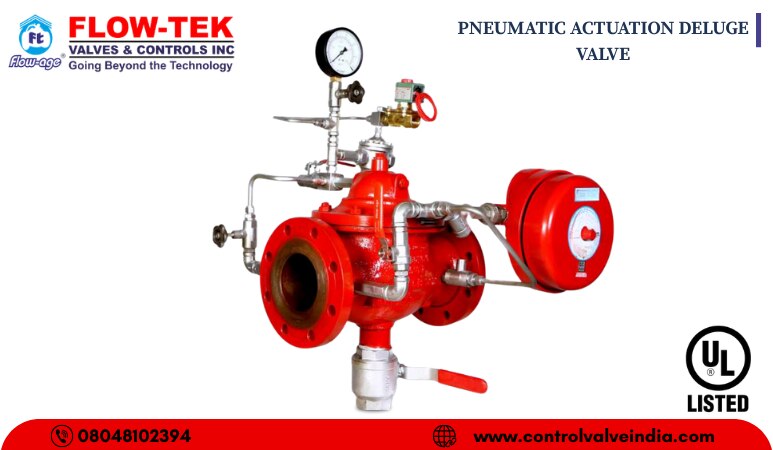
PNEUMATIC ACTUATION DELUGE VALVE
Description
Pneumatic Actuation Deluge Valve Manufacturer in India.
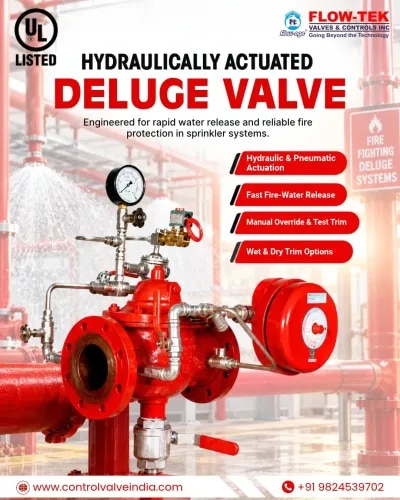
In industries that handle flammable materials, high temperatures, and combustible liquids, a dependable fire suppression system is essential. A Pneumatic Actuation Deluge Valve provides rapid fire protection by using compressed air or gas pressure to activate the main valve and release water or foam throughout a designated hazard area.
Flow-Tek Valves & Controls Inc. offers industrial deluge valve solutions designed for demanding fire protection applications. These valves use pneumatic pilot control technology to provide reliable activation without depending entirely on electrical releasing mechanisms. They are particularly suitable for installations where dependable mechanical and pneumatic operation is important.
As a trusted Pneumatic Actuation Deluge Valve Manufacturer in India, Flow-Tek focuses on durable construction, efficient valve operation, and application-specific configurations.
What Is a Pneumatic Actuation Deluge Valve?
A pneumatically actuated deluge valve is a hydraulically operated fire protection valve controlled through a pressurized pneumatic pilot line. It remains closed under normal conditions and opens when air pressure in the pilot system drops after fire detection.
Once activated, the valve allows a large volume of water to enter the downstream piping network and discharge through connected open sprinklers or spray nozzles.
This arrangement is especially useful in industrial environments requiring immediate, large-area fire suppression.
Working Principle of Pneumatically Actuated Deluge Valves
The valve operates through a combination of pneumatic pressure and hydraulic control.
1. Standby Condition: Water pressure in the priming chamber keeps the main diaphragm or clapper closed. The downstream distribution piping remains dry.
2. Fire Detection: Heat-sensitive devices or pneumatic pilot releases respond to fire conditions, decreasing air pressure in the pilot line.
3. Valve Activation: The pneumatic actuator releases pressure from the priming chamber, allowing the main valve to open.
4. Water Discharge: Pressurized water flows through the valve and reaches all connected open nozzles simultaneously.
5. System Reset: After the emergency, the water supply is isolated, the system is inspected, and the pneumatic and hydraulic control pressures are restored according to the manufacturer's procedure.
Technical Specifications
Flow-Tek provides configurations based on individual project and operating requirements.
• Valve Type: Pneumatically actuated diaphragm-type deluge valve
• Pressure Rating: Up to 16 bar (232 psi), depending on configuration
• Material Options: Cast iron, cast steel, and stainless steel
• Connection Size: DN 50 to DN 300, subject to model availability
• Actuation: Compressed air or pneumatic pilot control
• Manual Release: Available for emergency operation
• Operating Temperature: -20°C to 80°C, depending on configuration
• System Type: Pilot-operated hydraulic control
• Trim Options: Dry pilot, wet pilot, electric release, and hydraulic release
Key Features and Advantages
Choosing the right deluge valve improves the overall effectiveness of an industrial fire protection system.
• Pneumatic Activation: Uses compressed air to activate the valve.
• Dry Pilot Arrangement: Helps avoid water-filled pilot lines in environments where freezing is a concern.
• Rapid Water Discharge: Opens the main valve to supply water across the protected area.
• Manual Emergency Release: Provides an alternative activation method when required.
• Robust Construction: Material choices support demanding industrial operating conditions.
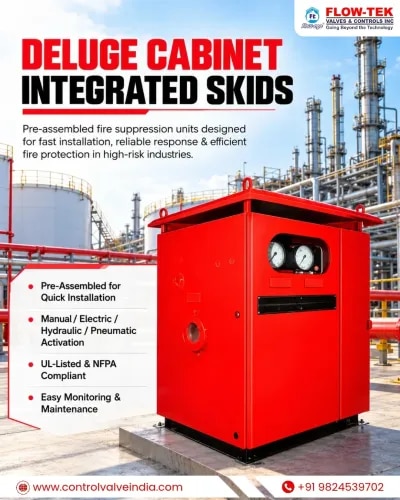
• Flexible Installation: Can be integrated into suitable fire protection piping and packaged skid arrangements.
• Simplified Maintenance: Accessible control trim supports routine inspection and servicing.
Industrial Applications
A pneumatic actuation deluge valve suits facilities where fire hazards require immediate suppression.
• Oil and Gas Refineries: Protects fuel storage tanks, pipelines, and processing units.
• Chemical and Petrochemical Plants: Supports fire suppression in areas handling flammable liquids and chemicals.
• Power Generation Plants: Protects turbines, transformers, and other critical equipment.
• Aircraft Hangars: Provides large-area water or foam distribution to protect aircraft.
• Offshore Platforms: Offers pneumatic release arrangements for demanding marine environments.
• Industrial Storage Facilities: Helps protect high-risk storage and manufacturing areas.
Pneumatic Actuation Deluge Valve Supplier in Gujarat
Flow-Tek Valves & Controls Inc provides industrial fire protection solutions for customers seeking dependable products and project-specific configurations.
If you are searching for a Pneumatic Actuation Deluge Valve Supplier in Gujarat, our product range can support different industrial applications. We also cater to inquiries from customers looking for a Pneumatic Actuation Deluge Valve Distributor in India or a Pneumatic Actuation Deluge Valve Manufacturer in Ahmedabad.
Our domestic and international business inquiries include buyers searching for a Top 5 Pneumatic Actuation Deluge Valve Exporter from India, a Pneumatic Actuation Deluge Valve Trader in Somalia, and a Pneumatic Actuation Deluge Valve Wholesaler in Ghana.
When evaluating Pneumatic Actuation Deluge Valve Manufacturers in India, consider pressure ratings, valve materials, pneumatic trim compatibility, certification requirements, and after-sales technical support before choosing.
Contact Flow-Tek Valves & Controls Inc.
Frequently Asked Questions (FAQs)
1. What is a pneumatic actuation deluge valve?
A fire protection control valve that uses compressed air or gas pressure in a pilot line to activate the main valve and release water or foam through open nozzles.
2. How does a pneumatic deluge valve operate?
During normal operation, hydraulic pressure keeps the main valve closed. When fire detection causes pneumatic pilot pressure to drop, the priming chamber loses pressure, and the main valve opens.
3. What is the purpose of a dry pilot line?
A dry pilot line uses compressed air or gas instead of water for detection and release control. It is particularly useful in installations exposed to low temperatures.
4. Where are pneumatic deluge valves commonly installed?
They are commonly used in oil refineries, chemical plants, power stations, aircraft hangars, offshore platforms, and fuel storage facilities.
5. Can a pneumatic deluge valve be operated manually?
Yes. Suitable configurations include a manual emergency release that lets you activate the system when needed.